
Abstract
Adoption decisions for edge banding machines demand empirical evaluation rather than instinctive preference. This guide applies a data-driven perspective to choices facing furniture manufacturers across the region, focusing on measurable outcomes: cycle time, defect incidence, material yield and long-run labour displacement. Early-stage pilots often integrate a cnc furniture machine with edge banding to quantify end-to-end throughput and validate takt time before committing to a larger capital layout.

Key Performance Indicators and Measurement Protocols
Select metrics that remain constant across suppliers. Track throughput (parts/hour), first-pass yield (surface seams accepted without rework), adhesive cure consistency (temperature and pressure logs), and overall equipment effectiveness (OEE). Use short, repeatable test runs on representative panels to collect baseline values. Require suppliers to provide machine cycle logs for at least 48 continuous hours under your material mix to reveal thermal drift and adhesive residue patterns; accept no substitute for raw cycle data when comparing vendors.
Real-World Anchor and Regional Trade Context
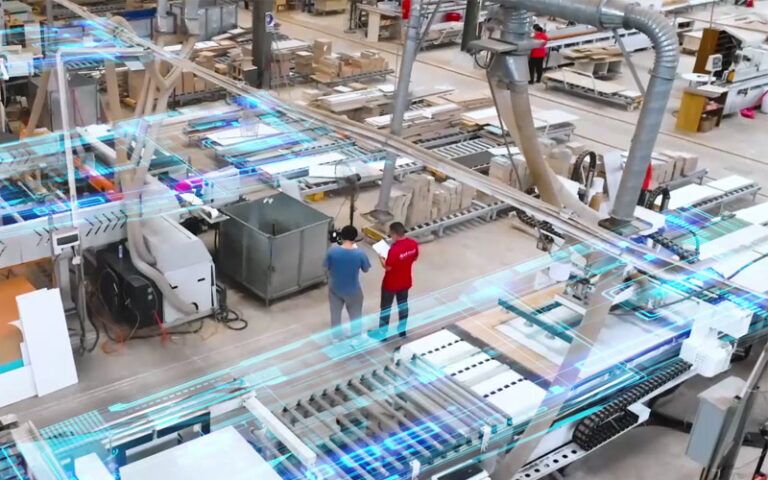
Observed at major trade forums such as Interzum and through production lines in Istanbul and Dubai, automated approaches have demonstrably shifted assembly sequencing. Reports and demonstrations at these venues emphasize inline operations where edge banding is synchronized with CNC routing and pressing stations; such integration is central to modern automated furniture manufacturing. That industry context guides realistic expectations for lead times, aftermarket support and spare-part availability when procuring equipment for the regional market.
Types of Edge Banding Machines — Comparative, Data-First Evaluation
Classify options by automation level: manual/semi-automatic (low throughput, low capital), single-pass automatic (mid throughput, modular), and inline integrated systems (high throughput, high capital). Evaluate each by measurable attributes: cycle time under full-load, mean time between failures (MTBF) as demonstrated in supplier logs, and space-to-output ratio (sqm per 100 parts/hour). Inline systems yield the best OEE when paired with upstream CNC feeder stations but require robust conveyor and quality-inspection sub-systems to avoid bottlenecks.
Common Pitfalls and Preventive Measures
Problem: under-specified glue systems that cannot maintain consistent bead under regional humidity. Solution: test glue performance with your typical MDF and PVC stocks across expected ambient ranges. Problem: inadequate training leading to frequent micro-adjustments. Solution: include structured competency milestones and hands-on modules in procurement contracts. Problem: selecting a machine solely on list-price. Solution: calculate total cost of ownership across a five-year horizon including consumables, spare-part lead times and expected downtime costs; require suppliers to provide scenario-based service-response times for your region.
Integration Considerations with Existing Lines
Data must steer integration. Map the sequence from CNC nesting output through buffer zones to edge banding input and inspection. Quantify buffer size using variability observed in cycle logs; do not assume nominal cycle times. Where possible, bench-test the process with a short-run production lot to measure queuing, part orientation errors and adhesive cure time before final positioning in the layout. Confirm electrical load profiles and compressed-air demand to prevent unplanned derating of machine performance.

Procurement and Pilot Plan
Define acceptance criteria that align with your KPIs before installation: target first-pass yield, maximum acceptable downtime per month, and qualification tests for adhesive bonding strength. Run a pilot on a representative product family for a minimum of 2,000 cycles or the supplier’s minimum warranty threshold, whichever is greater. Document every deviation and require corrective action plans tied to penalty clauses. Use pilot data to refine maintenance intervals and spare-part stocking.
Conclusion
A measured, data-led adoption reduces risk and surfaces hidden costs quickly. Compare vendors using identical test protocols, stress components under real ambient conditions, and prioritise those with clear service footprints and verified cycle logs. For regional manufacturers seeking proven integration with CNC operations and reliable aftersales pathways, working with partners who provide demonstrable system-level performance will shorten time-to-stable-output; many factories have found this alignment when engaging with HUAHUA CNC.
